The Game Has a Name
We have a name. The Cygnus Rift.
The Cygnus Rift is a real place — the northern end of the Great Rift, the dark lane of dust and gas that splits the Milky Way as we see it from Earth. It is not empty. It is thick with molecular dust and stellar nurseries, dense enough to blot out the stars behind it. That is where this game is set, and it is why the small states that survive out here survive at all: in the Rift, you can hide.
The working title is retired. The site, the log, and the documents now say Cygnus Rift.
That happened on Wednesday. Here is the rest of the week.
A note on pace, because the dates below will otherwise look strange: this is not evenings-and-weekends work. It is twelve to sixteen hours a day, seven days a week. That is the only way a project this size ever gets built by one person, and it is why a single week covers this much ground.
Tuesday — the documents, and six ships
The day started by closing out the document reconciliation: the whole design record reworked into a single set of files that comprise the "GDD", or Game Design Document. Weeks of scattered notes, superseded drafts, and half-rulings collapsed into something I can actually check a decision against.
Then six ship concepts, back to back. A freighter, three fighters, a bomber, and what could best be described as a racer of some sort. I start with hand sketches and then progress them into proper concept art.
A game with a lot of players needs a lot of ships. Not four hulls and a paint job — but a genuinely wide roster. Tastes vary enormously and the ship you want to fly is part of why you play. So the spread is deliberate: work out which silhouettes read as this game, then keep building outward from there.
Wednesday — a name, a look, and a dead end
Worked through a number of choices, and many possible locations, in search of a name — and finally found one that really worked, and that was going to influence many of the decisions we have made and will make: The Cygnus Rift. We then spent hours going back through the design documents to reconcile them against the new location. A name that is also a real place changes things: some material improves, some stops making sense, and some has to be rewritten because it assumed a different kind of space. Worth doing properly rather than search-and-replace.
Then the backdrops — look development, not technology. Seven look-dev proofs of concept: dark nebula cloudscapes, rim-lit in orange and teal, and quite a few variants on how the galactic band reads through dust. These are proofs that the look works as an environment. Whether they can be built and rendered properly was Friday's problem. Next was forging through a standard way to produce an understandable design language that could follow through the first set of zones.
Then a long stretch of ship research with, honestly, nothing to show for it. Hours of looking at other people's designs, working out what makes a hull read as fast, or heavy, or cheap, or military. No useful drawings came out of it. Some days are input only.
We also surveyed other space games — sims, combat games, single and multiplayer — to work out where Cygnus Rift actually sits. This was more "due diligence" to make sure our designs do work and to check if any of our designs are fundamentally flawed. (Thankfully not!)
The day ended on gameplay, which was a relief: camera behaviour under acceleration, pilot abilities and story paths, and the first proto-HUD.
Thursday — how do you know if a ship is balanced?
Most of the day on balance. Not numbers — method.
The question is simple to ask and horrible to answer: how do you tell whether two ships are equivalent when one is better in a straight line racing and the other is better in a scrappy knife fight? Tabletop wargames have been arguing about this for forty years, and the reasoning holds up better than anything modern. The trap is assuming that equal points means equal outcomes. It never does — overkill is wasted damage, thresholds are cliffs rather than slopes, and action economy is granular in ways the arithmetic hides.
There is a name for the general shape of this error, the Fuzzy Wuzzy Fallacy: two forces that cost the same on paper, and one of them reliably wins anyway, because the paper was measuring the wrong thing.
And feel matters as much as effectiveness. A ship that is mathematically fine but joyless is not balanced. It is just correct. The same goes for the all-rounder problem: a hull that is decent at everything can be numerically fair and still make every specialist feel pointless. We need glass cannons, tanks, all-rounders, bees, and they all must have their role. The all rounder needs to be "meh-ok" at lots of things, but never rival a specialist in their field of work.
The output was a framework for a tool to test intended outcomes against actual numbers, instead of eyeballing spreadsheets and hoping.
Ship work continued around it — more pilot hulls, a first look at capital ships, and the four core roles finally settled: Bomber, Scout, Fighter, and Support. Ships were drawn for each class, as if from one manufacturer — a family — so they read as related without being identical. That resemblance does real work: a player should be able to tell at a glance who built a hull and roughly what it is for.
Friday — the long arduous one
Star spheres, all day.
The star sphere is the backdrop a zone sits inside — the dust, the galactic band, the colour of the sky. It is most of what a player sees at any given moment, so it has to be right, and getting it right meant look development, which meant doing it wrong repeatedly until it stopped being wrong. Along the way it almost stopped being fun; but hey, this stuff is always fun. It was just a little taxing.
Researched the technical end of how these will need to be built in Unreal for the best visual experience. Researched the best high-resolution plates of the Milky Way. Worked out the rather annoying matting processes of semi-transparent dark nebulae with bright highlights over the mixed background of our galaxy — all while keeping that immense yet ethereal feeling.
Built and tested the pipeline for producing them. Specced a tool for making the individual elements that go into them. Got the first pass finished.
It was a long and arduous day and the honest summary is that there is now a working method where before there was not.
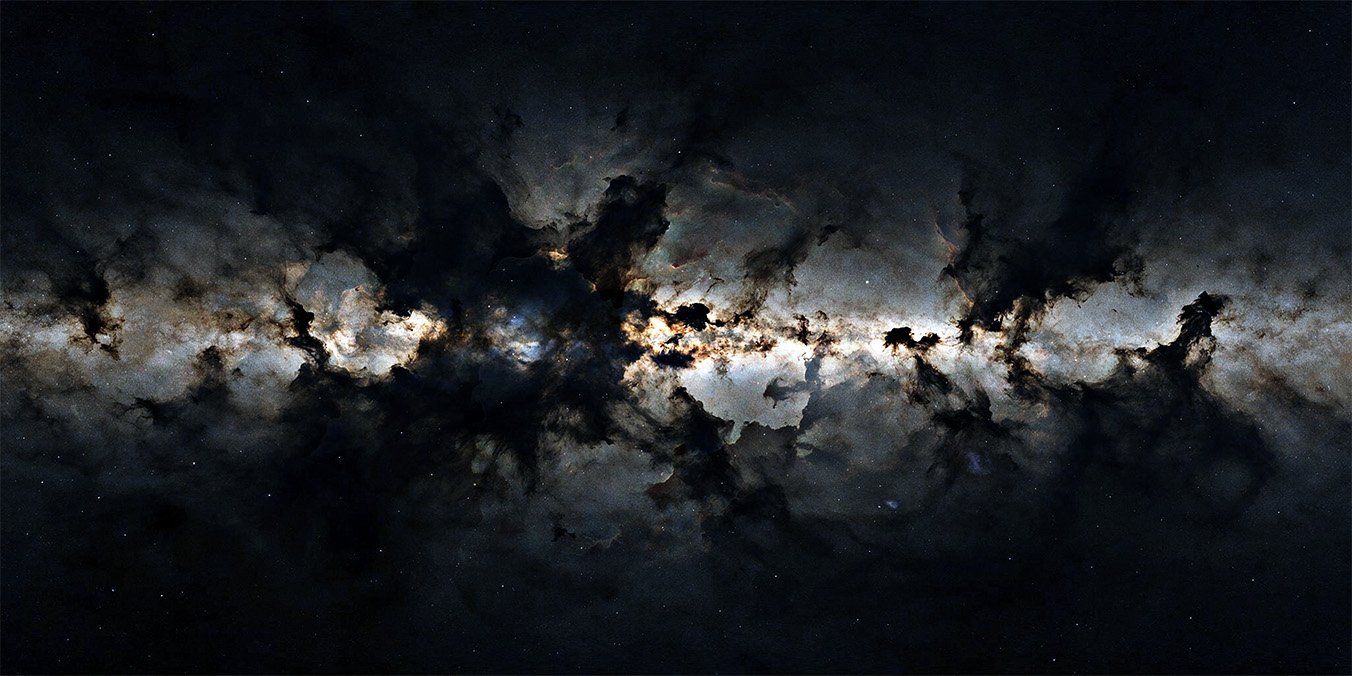
First star sphere look dev. The band is never severed, only interrupted — the dust is thick enough to hide behind, which is the whole reason anyone lives out here.
Saturday — the frigate
The first capital-class design: the MacKenzie Shield Frigate. Capital-ship support, built around a shield projector large enough to cover a sizable wing of players and walk them into close combat — the advancing umbrella that paces an assault. It works the other way too. Pointed at you, it is a formidable thing to take down.
Work also started on an escort carrier, which is a different problem entirely.
The rest of the day on tooling for asset production — machinery that helps streamline my design sketches into usable assets, so my time goes where it counts: the detailing and the specifics. First conversions came out on Saturday. They need work. But "needs work" is a different category from "does not exist," and that is progress.
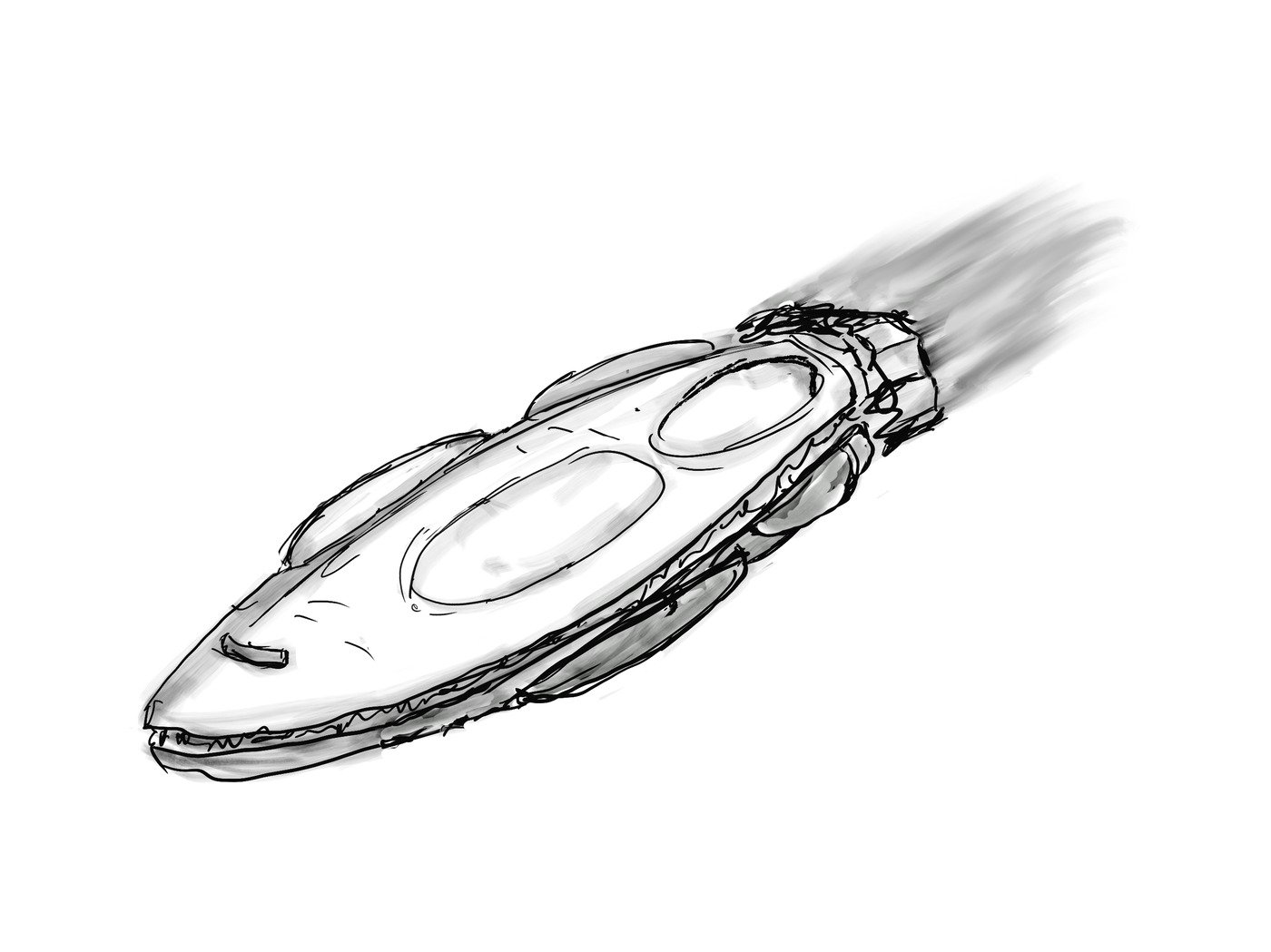
Where it starts. Blister hull, engine block aft, drawn by hand.
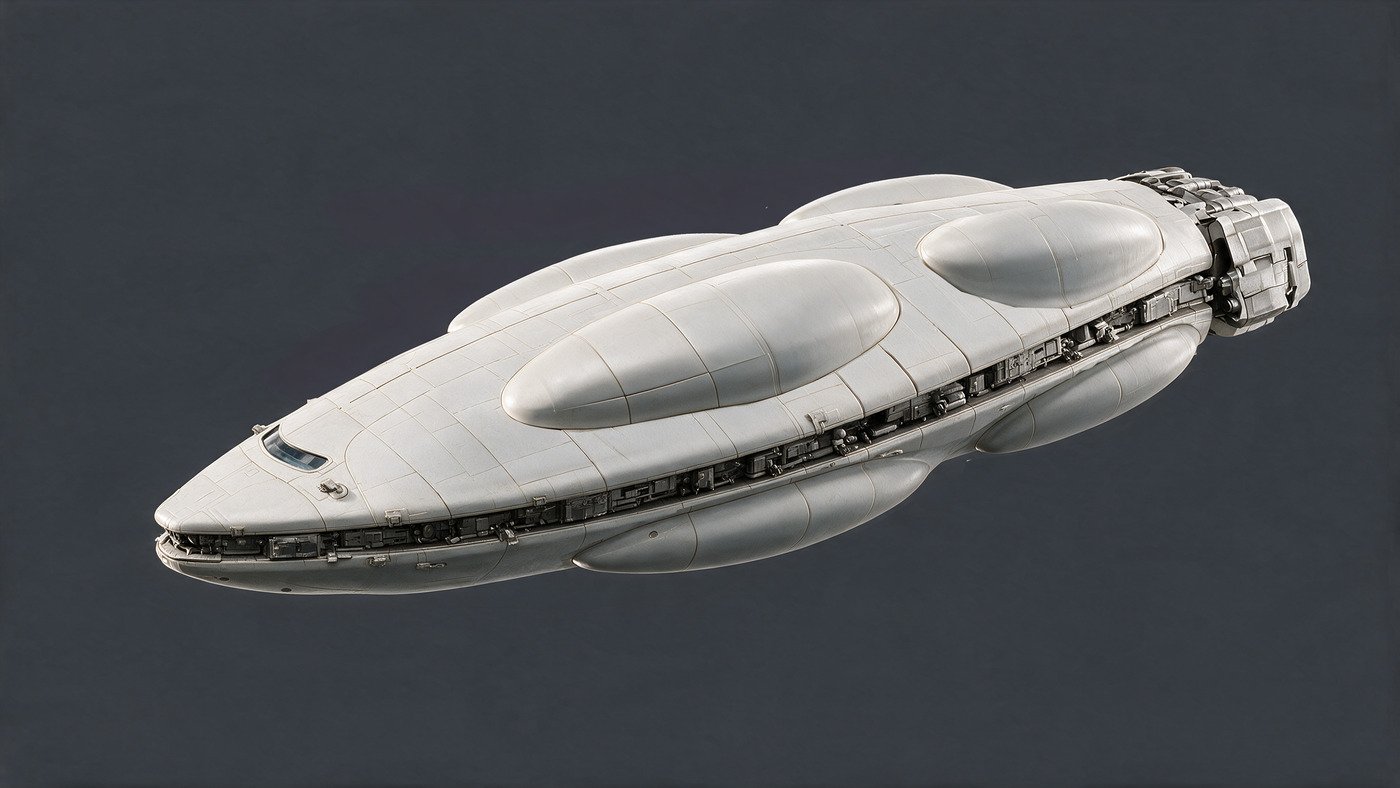
The same drawing put through the concept pipeline. Same proportions, same blister layout — now with surfaces to look at.
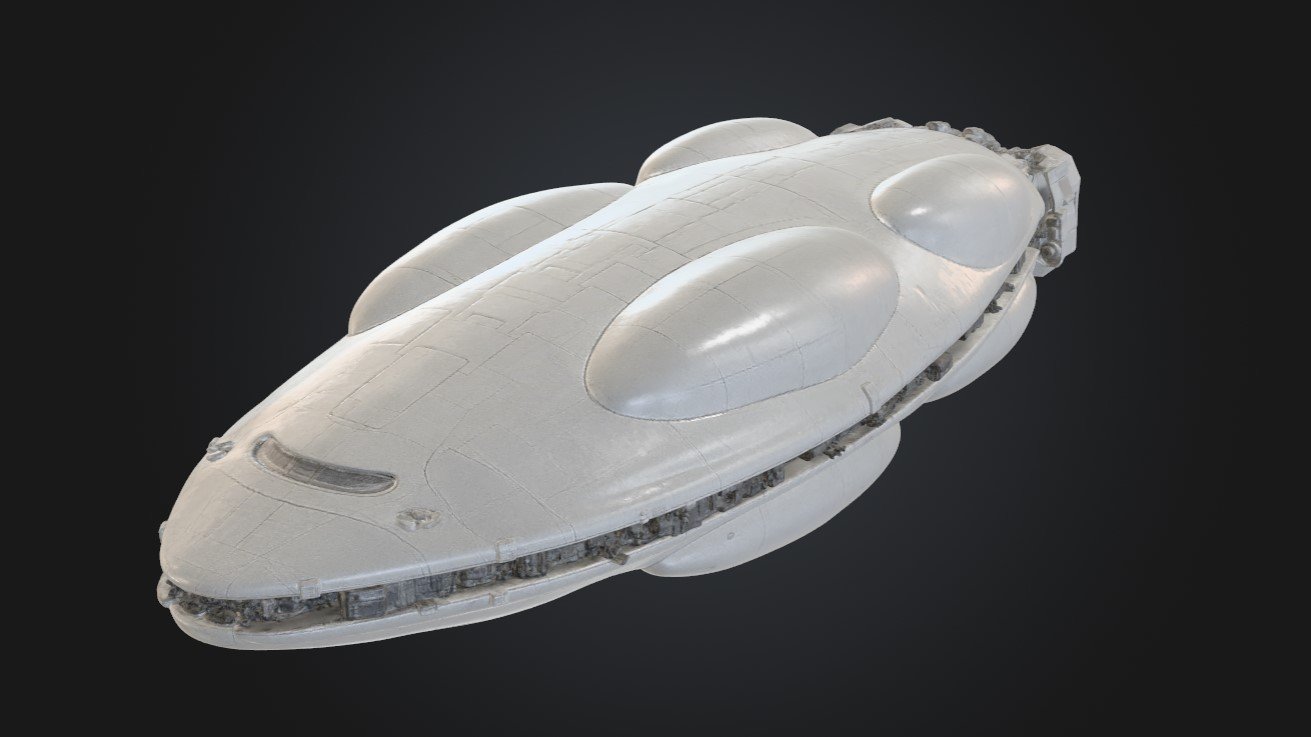
And blocked out as geometry. This is massing, not a finished model — it is soft, the panel work is mush, and it badly wants a retopology pass. But it is a shape in three dimensions that started as a pen line, and that is the point of the exercise.
Finished the day designing the visual effect for the shield projection itself, and got a stand-in frigate built with a few variants to choose between.
Sunday — the documents were already stale
Two document sweeps. The first because two days of new design had put collisions into a set of documents that had been finished on Tuesday. The second because a re-read found material that was ambiguous or easy to misread — not wrong, just capable of being taken the wrong way in six months. Both were worth doing. Neither is the sort of thing anybody puts in a trailer.
Then the biggest open question of the week: how big is a zone, and what is in it?
I went through Guild Wars 2, Elite Dangerous, and a handful of other instanced games — how they size a space, how many players they expect to hold, and what fills the gap between the interesting bits. And most importantly: what feels best? Where is the sweet spot between feeling empty and feeling crowded, regardless of the concurrent-player numbers? The honest answer is that none of them is doing quite what this game needs. That is useful in its own way — it means the numbers have to come from our own constraints rather than from copying someone.
That fed a due-diligence pass on how many zones the first season needs, whether a zone is one continuous volume or a set of sub-zones, and what actually occupies the space between points of interest when you are travelling — and how you travel: normal-space, super-space, hyper-space.
Alongside it, the first pass at what a zone is physically made of. Not just the content — rings, belts, and dust — but how they are made: authored density fields that materialise as you get near them, rather than millions of hand-placed objects. Cruise speed as a multiplier on the flight model that already exists, but in a compressed "super-space" between normal- and hyper-space.
Last thing on Sunday: examined in detail how level and rarity curves work in other large games, to work out how far our own rarity ladder should stretch, and laid out a three-layer gating stack — gear, charts, and story standing — so player progression feels natural and pilots don't end up in a zone or "game level" they are not ready for, without the game ever saying "no" to their face. The player who wanders somewhere dangerous should discover it and not be stopped at a wall or a rule. The gate keeper has to be diegetic. That being said, if a player goes somewhere that they are not prepared for, it's technically allowed, it's just not a guarantee that they'll survive.
Next: more zone work — what the edge of a zone actually is, and how cruise fits between them.