Built from Source
The engine is built. Not installed — built, from Epic's source code, on this desk. That is the difference between a game that can only run as a client and one that can run its own dedicated server. This was one of the biggest jobs of the first engineering phase, but I didn't have to do much… fire and forget primarily. This allowed me to spend a good chunk of time reacquainting myself with Blender. Much of the rest of the week went to building ships in Blender, and to a long stretch of research into both the fiction of our world and the gameplay of other people's space games. I took time out of engineering for a run of design sessions that kept successfully turning up decisions I'd been circling for weeks. We rounded the week out by reaching out to artists and looking into finances, mentorships, and funding sources.
Monday — building the engine
The engine we get from Epic's launcher is pre-built, and it cannot produce a dedicated server. We need the headless build that runs a zone with no screen and no player attached. To get one of those, we build the engine ourselves from source. So that was Monday down the drain!
This may not be surprising to anyone who's done this before, but I have not. The source comes as a nearly 3 GB archive that unpacks to nearly a quarter of a million files. The unpacker sat "Not Responding" for two hours with the file count frozen, then finished on its own. I was so close to killing this process so many times it's not funny. I was literally sitting there with the task manager open and the finger poised over the guillotine when the task bar jumped to life and started working. Maybe it just needed a threat… The setup pulled the engine's binary dependencies down throughout the day. The project files generated a solution a couple of hundred projects deep. The compile started at midnight and was done in about forty-five minutes — the fast end of what Epic quotes. Our build is pinned for now, but even if we continue point upgrades, I suspect we will stay on 5.8 for the duration.
The proof? Launch it! And the project browser opens under "Unreal Engine 5.8." I closed it without creating a project. That is the milestone. The engine can now produce a server. The second machine under the desk became that server's home, with a firewall rule for the game's port, a shared folder for builds, and its address written down.
I have this small network formed of machines that I've accumulated through the jobs I've worked on. My personal PC is OLD. It is an Overclockers off-the-shelf machine that was a hand-me-down from when I was at Unity Technologies and they didn't want it back. I did add some memory and an RTX-3060. I have an HP Z440 that I built from all refurbished parts for when I was working on Wes Anderson's Asteroid City and the "Henry Sugar Shorts" for Netflix. I have an HP Z8G4 with an RTX-3090Ti (iirc), two CPUs, and a boatload of RAM for when I was working on The Magic Faraway Tree. This, like the Z440, was all used or refurbished parts aside from a few components like the extra external extractor fan I added and a few other case mods. This is all connected on a little network with a hefty 20+ TB archive disk and a small NAS (a network-attached storage box). The plan is to keep the hardcore work on the Z8G4 and use the Z440 as the local server, but that will eventually migrate to the cloud when we need to.
The machine setup will also let me run tests from our target "floor" and investigate our potential "ceiling". I'll buy an RTX-2060 for the Z440 and make that the minimum spec machine. The Overclockers PC — late "teens" architecture and a 3060 — is the median, and the Z8G4 with a 3090Ti is the gate to the "ceiling". One of these days, if money comes in, I'll get a top end card to actually test the top end, but the difference between the 3090Ti and other cards is small enough that if we can get a damned good ultimate-like game on it, then anyone with a super boffin card will just play at a higher frame rate.
This was a strange split day with long processes chugging around in the background while I did maintenance and research and modelling in the foreground. The day ended with a sweep and tidy pass across the design set to make sure a GDD (game design document) under the full load and churn of development was not stale or contradictory.
Tuesday — ship balance, protecting the player experience, defence systems, and contested space
A long day, running into a day and a half, went to design work on ship design and combat balance. It had one aim: your choice of ship design or skin never compromises fairness in the game. Unlike a game where all the players are arguably humanoid, ship design has a lot of unique features and ships present a whole host of different profiles to the opponent's targeting system. All ship designs must be as balanced as possible, or our game will be selling ship designs as "pay to win" through the cosmetics door, and we don't want to do that. We've chosen to have balanced "chassis" design, and ship designs within that chassis class are cosmetic. We specifically don't want people grinding ship designs for an edge, and don't want a tree of stronger and faster ships stretching off the screen in either direction. That's the domain of grind-to-win and pay-to-jump-the-queue games. We want the playing field to be balanced and allow the better pilot to be more effective — because they can pilot their ship well, not because the ship the player bought is doing the work for them. Player experience protected, full stop. Moreover… in planned structured PvP (player versus player) and large scale FvF (Faction vs Faction) zones, this will be critical.
Two more rulings came out of the same session.
Defence has three paths, not one. Ship and combat design can easily drift towards "shield-primary" as the default way to build. It's just part of the genre. We just wanted to make clear in our minds and documentation that Defence is a co-equal, three way split, when building a ship's loadout — shield, armour, and all-round — and none of them is the intended one. Whether all three stay competitive under the energy economy is an open question that only play will answer. The theory is that there will be "Armour" for hull reinforcement, which does not regenerate; shields — a bubble around the ship — that regenerate from the ship's engine supply but can be broken; and a balance of both.
This leads into power management and mass.
Mass is one of our clear limiting stats. A player can choose to have both armour and shields, but the mass will be higher and the energy consumption split. A player who chooses armour only can have more energy for weapons, but the defence won't regenerate. A player can have a lighter, more nimble ship and run shields only, but defence is down to energy only with the bare chassis underneath. Weapons will have the same split: kinetic weapons require minimal energy, energy weapons? Well… they'll require more energy. I imagine there may be "splits" where players will experiment with Shields and Kinetics or Armour and Energy… but as the weapons won't behave the same versus Shields and Armour and Chassis… there will be players who go for a hybrid build… And then there are utility slots… and ordnance…
That's your choice. It'll be up to you how you like to fly.
Contested space has firmed up. Faction-versus-faction play, with pilots bringing their own ships to the fight, is restored as a named feature for the future. We somehow dropped it out of the GDD during a sweep. FvF won't be in the initial release, and the mechanics aren't designed, but this has been in the conceptual design from the beginning and we need to keep all the gates open for those future plans. No rebuilding ship and combat design because we ignored PvP during the combat build phase.
Engineering Pass. One more thing was settled this week: how the build itself gets judged. We have already written engineering milestones and have made each one a gate — a test it either passes or fails. But we need to make sure these are not hollow milestones. Every gate has to be cleared by the real "machinery". Short term work for long term gain. All milestones and proofs must be on the foundation of systems that we will take forward, even if it slows the engineering phase in the short term. What I was realising as I was standing on the edge of the empty swimming pool with my skateboard and reviewing the plan was that we could prove a stage, 100%, and declare a legitimate victory… on a test framework. And then we'd have to rip that down and start building the real thing.
There were several issues here: the build time saved to make a temp testing object or system to get proof of concept just gets lost as wasted effort. It may make us feel success quicker, but it's a false feeling. There is also the chance that the "real" object or system may perform differently, but… the most critical issue for me is that removing and replacing content in code could leave stubs, dead-end or spaghetti code, or just break something we missed.
With that in mind I want to build it more slowly and more steadily… so each system IS the real system and we throw away as little as possible.
Wednesday — ships
Wednesday was an extensive day on research, ship builds, and ship designs. This is a bit of a fudge and smudge as the entire week was mixed with lots of parallel streams — engineering builds, ship design, ship building, research, and more. Not a very clean narrative this week, especially here in the middle. Suffice it to say that I did spend a lot of time in Blender and here are a few more images of the heavy fighter.
I build the actual geometry in Blender, but the design happens in Procreate, the iPad drawing app, where each ship starts as a sketch before anything gets modelled. Wednesday was the long stretch of it.
This is the model I've been teasing over the last few logs, and the sketch that started it.
Heavy Fighter: The original Procreate sketch
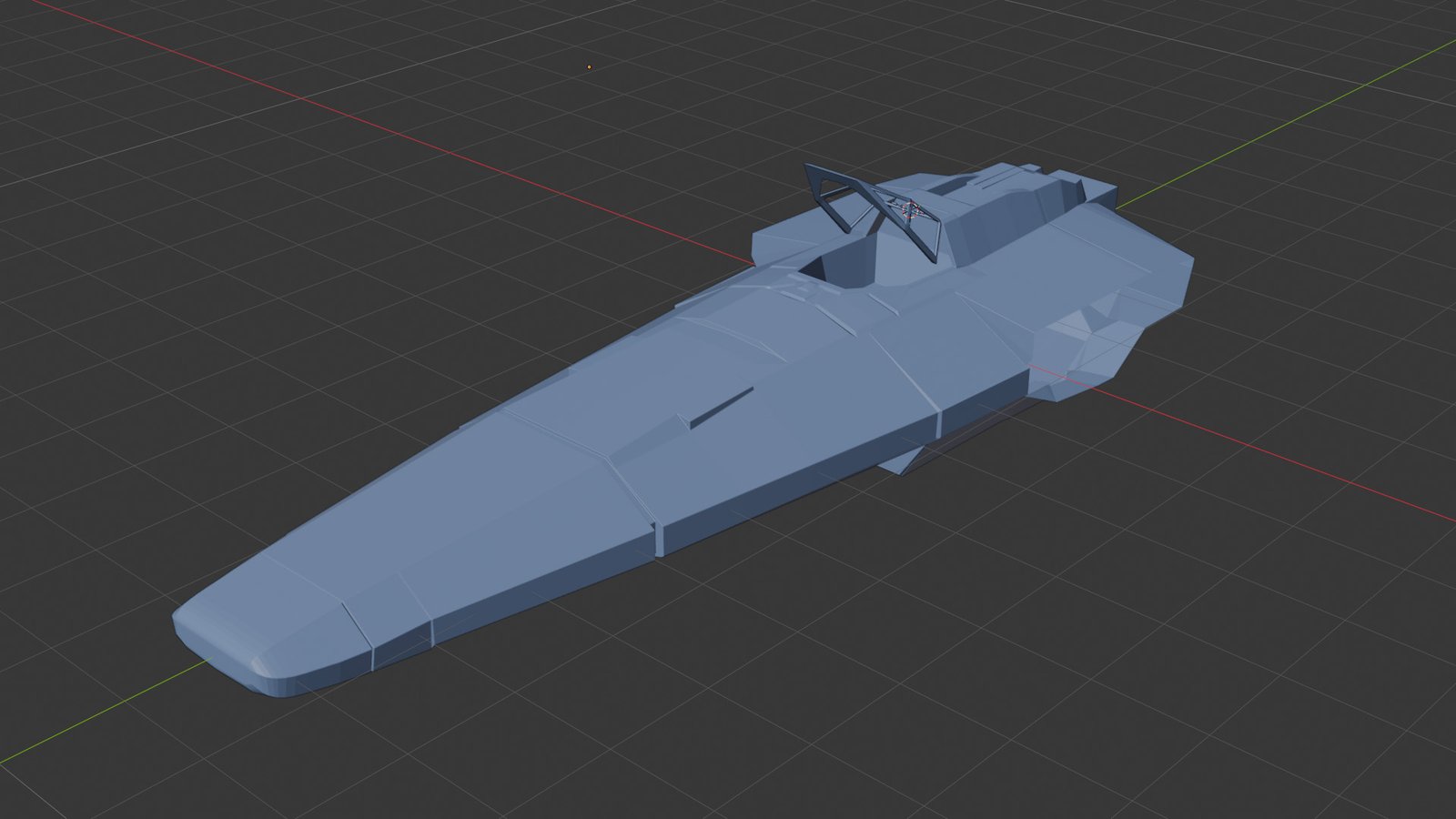
Heavy Fighter: Main Fuselage with Cockpit Open. This is a shell only with no engines, no greebles, and no internal spaces defined.
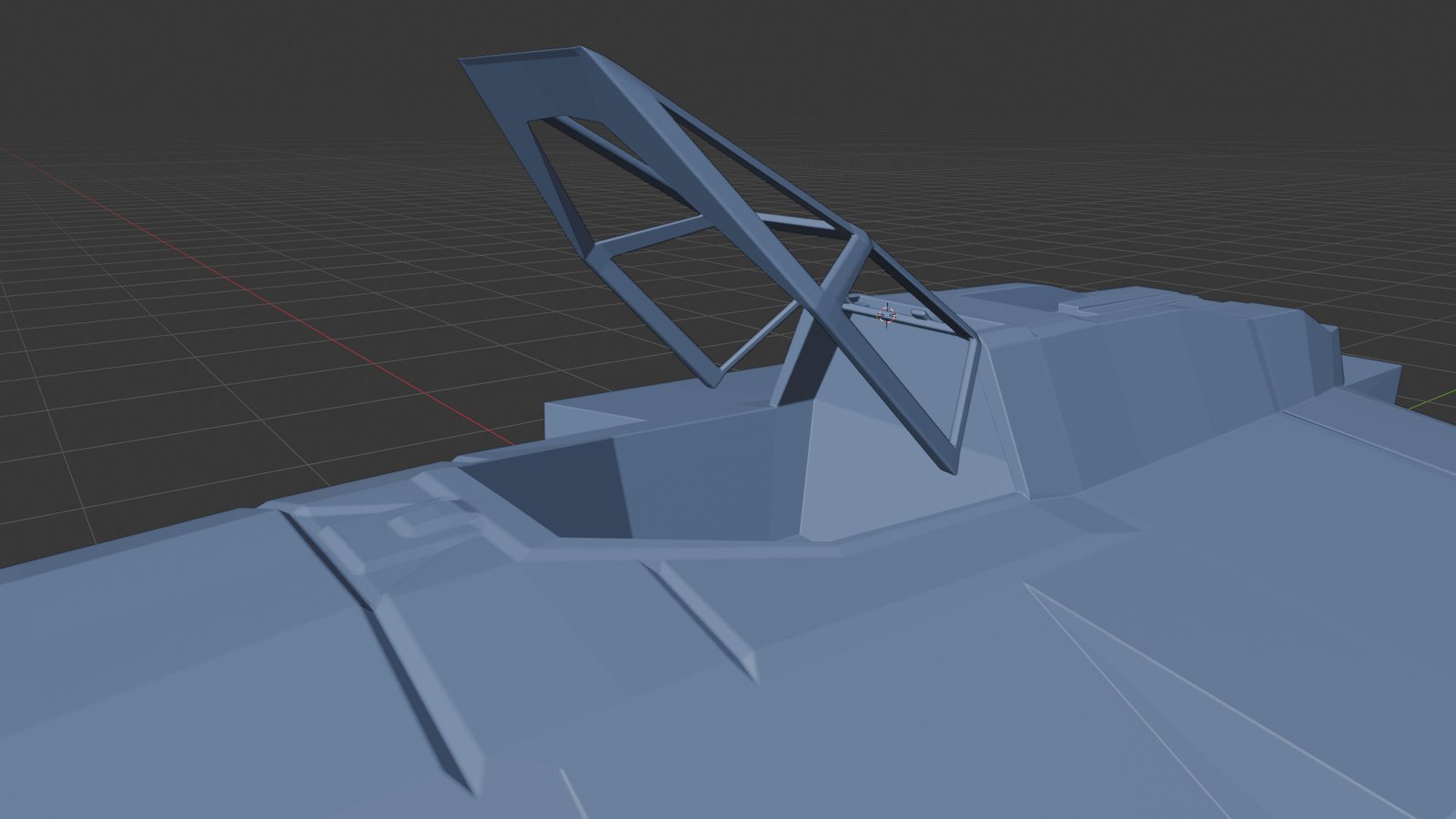
Close on the Open Cockpit.
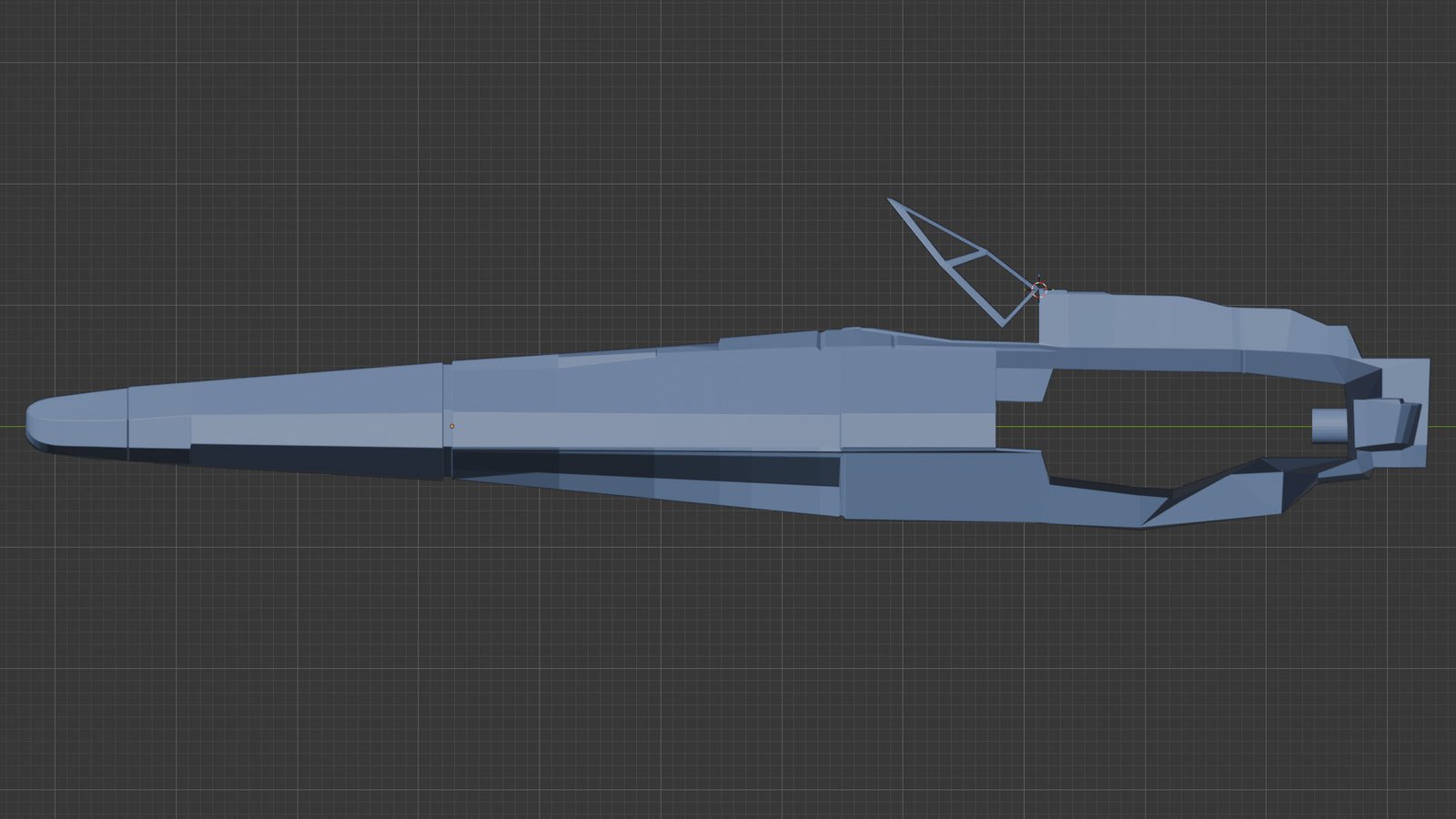
Heavy Fighter: Profile View with Cockpit Open.
Ship work in general ran through the entire week alongside everything else we have been doing.
With this ship, I'm making sure there are slots and geometry for kinetic weapons, energy weapons, torpedoes, and ordnance. My feeling is — sticking to my slice of the genre — that these weapons, when installed, will be fixed to the hull. I'm going back to source and looking at WW2 fighter aircraft. I'm not yet ready for the hidden weapons bays and deployable weapons that some games have.
Thursday and Friday — the long road, and more ships
Thursday and Friday went into long term planning. I am looking into finance and funding, and for that I need a long term schedule, and not just a list of Engineering Days. I need to see calendar days and all content. So — with that in mind, I've been tracking application dates for several funding mechanisms and looking at what we need to prepare before they arrive. I'm also looking into the shape of the road to play-testing and Early Access. One critical point for finding and preparing for UK funding applications is a named UK asset provider, so lots of outreach to people I have worked with. Friday carried on along this path of funding and planning with a long half day of meetings with potential contract vendors and a business mentor, covering funding, business development, and independence from the sophonic overlords. The rest of both days was a mixture of ship work and research.
Saturday — what's out there, and what it feels like
Two questions had been circling for weeks. Saturday answered the first and set up the second.
What does a solo pilot find "out there"? Our focus has been on a higher level than the specifics of exploring: progression, FvF, metas, ship design, server architecture. We have discussed the obvious: an encounter system, whether it can reach players in "cruise" as well as "normal space", that sort of thing. I wanted to know what the equivalent of "just exploring" is. What's out there? What is the equivalent of "finding that vista and the undiscovered waterfall"? The obvious came up: removing the cockpit and ship and allowing a free look all around, unoccluded. We settled on diegetically having a "camera drone" that the player could "launch" that orbits the ship and allows a composed ship photo, but would (probably) be limited to photo opportunities, not used as a tool (unless we have some sort of in-game upgrade to it).
We did work extensively on content, but I don't want to detail it now, both because much of it is unfinished and much of it might be a spoiler.
The player should feel like they're in a movie. Working through what the player experience should be, the terms that come to mind are diegetic, cinematic, and plausible. I want the player to FEEL like they are in a movie. It is also why we have spent the time on things that might have looked like detail for its own sake: a ship destruction that feels like old-school miniatures blowing up, formations with wingmates so groups can cruise together and players can see their wingmates alongside. We want those moments — and not as cinematics that you watch, but as a cinematic experience that you can live. Some of the ideas that come out of this point of view go beyond the feedback in the cockpit: all tutorials will be story-driven and clear in their goal. In story mode, you will meet and maintain relationships with long-term characters who go through arcs and growth. Visually we will build everything for a cinematic feeling, but the actions (see below) should also feel like you are in the moment, and in the movie version of the moment.
Changing your build in the field. Later on there will be a diegetically solid way to change builds in the field, and it won't be free. The proposal on the table is being able to find and build a "coupling" in the chassis's infrastructure that lets you swap weapon connections when away from the station. It comes at a cost: both weapons (or items) must be equipped, adding mass to your ship and occupying slots. The power plant must be shut off and power winds down to nothing. Without power — weapons, shields, and life support all drop while you do it. Get attacked mid-swap and you will not be a happy camper. It is earned, not given, and it doesn't replace the Bench — the ship-build viewer, both in-game and offline — which stays the best method for a deep rework. It is not decided; it is written up for the next pass. This fits with "diegetic, cinematic, and plausible", and should be balanced to the point where the cost of the delay and the risk of the changeover is worth the effort and spares the pilot from having to truck all the way back to a station for a refit.
O.P. Brand. It's still "Saturday". A long stretch of the day went to O.P. Branded (other people's) space games, as research into what keeps us flying and what makes us want to quit, and to get a feel of what other games feel it good space flight mechanics. I bought Star Wars: Squadrons on Steam as I'd erased EA and my original copy from my computer. It was now significantly less than the price of a flat white or pint of bitter, so not worth the pain of trying to figure out any of my long since mentally purged details. I gave it a go and it made me terribly depressed. Such an awful game — and yet, while not perfect, it's a good example AA space flight. I played the 2 or 3 "prologue" scenarios… and was surprised that I won an achievement: Completing the Prologue! … And only 56.6% of players had reached that goal. (Oh dear…) The rest were surveyed rather than played: Elite Dangerous (which I have played a LOT of), Star Citizen, Star Conflict, Rebel Galaxy and Rebel Galaxy Outlaw, and Everspace 2. I also learned about a new game, if you count this as "new": X-Wing Alliance. I somehow missed this one. I learned about it for the first time when sweeping space combat games and need to check it out. Everspace 2 gave the cleanest contrast. Its travel-time moments map to our cruise, not to the zone jump. Its random encounter content maps to our "hails and offers" that we have planned. These are the signals the world sends you about things that might be worth checking out. The one major difference is that, as we are a permanent and living world, the random-encounter-that-becomes-a-permanent-feature aspect needs to sit on our permanent and authored layer. One idea we are exploring is "instanced sub-zones" such as an ionised gas cloud… where the results are content that only a single player can revisit — or the player needs to lead a group in formation to find it… but again… these are sketches on the drawing board.
This comes back to the "what's out there?" question. I'm a firm believer in strong solo content alongside a large living and breathing world. I have met many players who love the massive groups — metas, champions, zergs (huge player swarms) of group versus group… and in our case fleet battles; but I also know people who really just want to be alone together, and those that enjoy the entire gamut. I don't want the solo experience to be lost in the turmoil coming from the mosh pit.
Sunday — story, and the second half of exploration
I did over a half day doing research and development into story ideas and trying to make them scientifically plausible. Can't go into the details as it would be a terrible spoiler, but it's really really cool, and I've learned more today about science than I have in a long time… and I'm afraid you'll just have to wait for it to surface in the game!
Saturday's reveal started to help answer what exploration looks like. We continued that on Sunday. We also explored completion — both on maps and "masteries" (to lift a Guild Wars 2, or GW2, term) of an area. We also explored reputation and the rewards for participation, both pros and cons; the advantage and ugliness of dailies (the daily task list), a map with a completion bar, gating content. We also looked at progress and how to keep it to prestige, convenience, and/or versatility — never raw power. There does need to be a noticeable power curve, but not an infinite one. One item we are looking into, on the completion front, is progression that is gear-based. Explore a zone with Mk1 sensor gear, and if we track that form of completion, getting Mk2 sensor gear later in the game will reveal more content in earlier zones. That isn't lost progress; it's "new signatures detected." A zone you have finished isn't finished. What these actually are is still open, but there is the three-word test for anything that goes into them: Diegetic, Cinematic, Plausible.
Lastly we reviewed crewed corvettes — one pilot flying, others on the turrets or the bomb rack. These will be gated specialist craft, not the default: the "Turtle Mounts" (GW2 terms again) of The Cygnus Rift. We also reviewed how we will scale metas — the large scheduled events that draw pilots together — to the population actually present. We suspect that they may gate before they escalate, rather than escalating following the meta template. For example, if the beginning of the meta requires a pre-event, and the pre-events fail or are ignored, that will be a gate determining an outcome. If the pre-events are complete, but there is only one pilot engaged in the next stage, that may be the end of the meta — the carrier frigate appears with a raiding party… but the capital ship never arrives… This will be some sort of behaviour tree or state machine with gates and switches… both to keep the regular experience interesting and players on their toes… but also to prevent constant unavoidable failure with a potentially low population.
That leads to an opinion on event timers. Scheduled metas are good for getting people together. Players know that it's about time to down the pickaxes and move towards a potential event. Meta trains — hopping from one scheduled event to the next on rails — are the pattern to avoid. It may become that timers are a dial, not a rule, and the event window isn't fixed. Regular event timers could just get scrapped, leading to a more diegetic sense of the lurking enemy. So — we may skip them altogether if they feel crap, or bring them back if players need that regularity… still to be decided.
The engine is standing, the server has a home, the ships are coming up, and the design is closer to buildable than it was a week ago.
Next: the ship's data — what a chassis, a skin and an item actually are, in the code. It is the least glamorous thing on the list, and the server has nothing to carry until it exists.